0

Post of the Day: Credit Squeeze Still in `Early Days'

One investor worth watching (and listening to) is Prem Watsa of Fairfax Financial (FFH). In this Bloomberg article he states that we are still going to see more pain in the Credit Markets.

If you haven't read about the "Candian Warren Buffett" then you should read this excellent story on Watsa.

Here is an quote from the Bloomberg article:


We're just rolling through mortgages right now, but we haven't gone through all the other areas yet,'' such as credit- card debt, commercial real estate loans and automobile lending, Watsa said."


Enjoy!

0

Post of the Day: "Katsenelson Predicts"

For my inaugural post of the day I'm linking to the Value Investing Congress's Blog. In this post Vitaliy Katsenelson talks about the difficulties the financial markets are currently experiencing and the ways he predicts that it may play out. Here is an excerpt:

- The US economy will slip into a recession which will last longer than those of the past. The longer this recession lasts – the longer it will last. Economic weakness will feed on itself and cause higher unemployment, which will cause further defaults on loans, and so on.
- The defaults in the financial sector will reach higher levels than we saw in the last recession.
- Lending standards will go from extreme promiscuity to the level of a store manager in the sitcom Married with Children, when a store manager, tired of Al Bundy’s bounced checks, asked him for “cash and three forms of ID”.
- This will also spill over into the corporate sector. In many instances it already has: access to capital markets has of late been considered a birthright, but it is quickly turning into a privilege reserved for an elite few and, in many, cases a source of competitive advantage.
- Oversupply of houses and tighter lending standards will cause the housing market to recover slower than many expect (or are hoping).
- Worst case, we will take the rest of the world into a recession. Slowdown in growth will send the Chinese economy into a deflationary spiral. We’ll learn that the prosperity of the Chinese economy came at the expense of a pile of bad loans which were covered up by high growth. Exposure to BRIC countries that used to be considered an asset may quickly turn into a liability. The global commodity boom will turn into a bust.
- Finally, corporate profit margins will prove unsustainable. They are at all time high (40% above the mean), soon to embark on the journey toward mean reversion, where corporate earnings will either decline or growth will decelerate. Stocks may not appear so cheap anymore."


Click HERE to read the rest of the post.

0

John Burr Williams says "Discounting Matters"

Intuition


In his 1938 investing text "The Theory of Investment Value" John Burr Williams introduced the ideas of discounting and intrinsic value to investors.

For our purposes "intrinsic value" is synonymous with the value of a business. The value can be expressed as the value of the entire enterprise or (to make easier to compare to the stock price) as a per share value.

"Discounting" is a way of expressing something we understand intuitively, that a dollar today is worth more than a dollar a year from know.

No this isn't another dig on the U.S. dollar. This is true even if our currency wasn't under pressure. No one likes to wait around to reinvest their earnings. If we have to wait then we reasonably expect to be compensated for our time. This compensation for waiting is expressed as a rate, in this case as a discount rate. A discount rate represents our opportunity cost of waiting for a certain cash flow.

A Little Math: What should we pay today to receive $100 in the future?


Let's explore for a moment the math behind discounting the cash paid to us in the future. Here is the formula:PV=FV/(1+i)^n
Example: What should we pay today to receive $100 in the future? Let's make a couple of assumptions.
  1. We will take the money to purchase the future $100 out of our savings yielding 5% (Our opportunity cost or discount rate).
  2. We are willing to wait 1, 5, or 10 years.
Using those assumptions: Future Value (FV) = $100; Discount Rate (i)= 5% or 0.05; Number of Periods (n) =1

What should we be willing to pay for a cash flow with those characteristics? $95.24

What if we wait 5 years (n=5)? $78.35

And 10 years (n=10)? Only $61.39

Clarification


The implications of the Future Value of money might not be entirely clear. Discounting future cash flows helps us avoid overpaying for money received in the future; our required rate of return is built into the equation. Said another way, should you decide to purchase that 2018 cash flow of $100 for $61.39 today you are assured a 5% rate of return. Clear as mud?

More on why discounting cash flows matter in future posts...

1

Valuation Matters: A Case for Business Valuation

Every Business has a Value


Off Wall Street and outside of lecture halls the idea that every business has a certain value that a prospective owner would pay for the complete enterprise is intuitive. In fact, playing Monopoly with my eight year old and watching her haggle for Illinois Ave. illustrates just how intuitive price vs. value is, but somewhere between elementary school and when we first look at a stock's ticker we get lost. We start assuming that the stock price represents the business's value. This is usually not true.

Ignore Stock Prices


Let's look at a large stable company's stock price over the last year. I'm going to use Johnson & Johnson (JNJ) as my example, but any company would do. Here is a one year chart of the stock price:
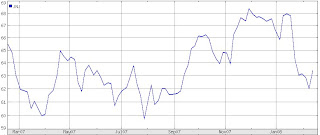
JNJ 1 Year Stock Price Fluctuations
Theoretically, an investor could have purchased JNJ for as little as $173 Billion or as high as $196 Billion over just 52 weeks. Do you really think that Johnson & Johnson's business value fluctuated by $23 Billion? That is what the stock price suggests. Let's look at another company's stock price Apple (AAPL) to see if its price gyrations are equally irrational.


52 weeks ago you could buy Apple for about $73 Billion then it shot up $100 Billion to $178 Billion and now you can buy it for less than $110 Billion. Talk about a roller coaster! Unlike amusement parks -watching charts, stock prices, and the market is hazardous to both your health and your wealth.

A business's value changes much more slowly than the quoted stock price. Over the short term the stock price is a proxy for investors expectations and emotions (two things that, for the most part, should be ignored).

Price Equals Value


Price is what you pay for, value is what you get"
-Warren Buffett


As investors we can profit by purchasing business when there is a large discrepancy between the price the market is offering a company for and the value of the underlying business. It is important to note that business's value isn't quoted on the stock market (or anywhere else) so it will take bit more work to find bargains. In future posts we will explore business valuation tools.

Efficient Markets


If you disagree, believe the market is efficient, or find that the idea that there is a disconnect between price and value inherently flawed, then I suggest investing in a low cost index fund. Please read my post on why indexing matters. There is nothing wrong with investing passively AND earning your fair share of the market's return. I'm very happy that many people subscribe to the Efficient Market Theory (I.e. Price = Value Theory) it creates opportunities for the enterprising investor.

Tea Leaves, Soothsayers, and Technical Analysis


Worse yet, if feel that the charts, and therefor the price, is signaling you and believe in soothsayers, tea leaves, and fortune tellers then you should search for "technical analysis" on your favorite search engine.