Showing posts with label Warren Buffett. Show all posts
0

Is Buffett's Business Model More Lucrative than a Hedge Fund?

Arohan of Arohans's Investing Life thinks so:

The difference is in the business models. A hedge fund manager primarily derives his income from fees. The assets of the hedge fund are owned by investors in the fund and only a part of the growth in the value of this asset works towards increasing the net worth of the hedge fund manager...If you are a superlative investor (like Mr Buffet or like many of the better hedge fund managers), business ownership model of Berkshire Hathaway will generate greater wealth over a long period of time. Sure, running a hedge fund will get you to great riches quickly (adding lot of investors quickly, in the years where the fund does very well, etc), but it is not a superior wealth creation machine over long term" Continue Reading


Arohan has a great site and has sponsored my blog through Entrecard. So, if you found this article through Entrecard please "drop" on his widget.

0

Charlie Munger Interview

I highly recommend reading everything you can about Warren Buffett's partner Charlie Munger. If you are unfamiliar with him you are in for a treat. He is incredibly intelligent and he knows it -which adds a certain (well deserved) brashness and arrogance to his message. For me this makes him that much more engaging.

Here are some notes from a recent interview. I recommend visiting him at the Berkshire and Westco meetings so that you can experience him in person. I GUARANTEE you'll learn something.

Tonight I got to see A Conversation with Charlie Munger at Caltech in Pasadena. I took some notes on the discussion below. C refers to Charlie Munger speaking, while T stands for Tom Tombrello, the interviewer. These are not their exact words.


C: I love Occum's Razor (Wikipedia). Einstein once said make everything as simple as possible, but not simpler. In the field of messy social sciences, use a variety of disciplines and look for a confluence of factors when dealing with "lollapaloozas". (significant and strange events, black swans)

For example, I was fascinated about what made people join Moonies, a cult-like group. It didn't make sense until I ran into Pavlov, who experimented on dogs by pushing them to nervous breakdowns (He did this by locking them in cages and then raising the water level up to mouth height, making them think they were about to drown) . Afterwards, they would act in the complete opposite fashion. This was very similar to one of the Moonies conversion methods: "causing the target to snap".
Continue the Interview

2

Post of the Day: Great Businesses According to Buffett

Today's post of the day is from George at Fat Pitch Financials:

I finished digesting the latest Berkshire Hathaway 2007 letter to shareholders today. I found the most interesting part of this year’s letter was Warren Buffett’s discussion of what kinds of businesses turn him on.

The companies that he and Charlie Munger look for are:

  1. Understandable
  2. Businesses with favorable long-term economics
  3. Run by trustworthy management
  4. Selling at sensible prices
Mr. Buffett once again reiterates that “a truly great business must have an enduring ‘moat’ that protects excellent returns on invested capital.” Fat Pitch Financials has been all about finding companies with wide moats ever since I first set up this blog in 2004. Given my economics background, I find Buffett’s arguement for the need for wide moats compelling. He argues that companies that lack a barrier to competition will succumb to the competitive forces of a capitalist market that tend to drive profits to zero."
Continue Reading

0

Post of the Day: 10 Investing Tips From Warren Buffett

From the 2007 Letter to Shareholders:

1. When you know you're the best, you can afford to tell it like it is. Buffett says: "Our insurance business had an excellent year... that party is over. It's a certainty that insurance-industry profit margins, including ours, will fall significantly in 2008. So be prepared for lower insurance earnings during the next few years."

2. Only four things really count when making an investment (or buying whole companies if, like Buffett, you have $141bn to spend) - "a business you understand, favourable long-term economics, able and trustworthy management, and a sensible price tag". That's investment, everything else is speculation.

3. Invest this way and you don't need to constantly look for the next "new" thing, with all the risk that necessarily entails.

Buffett's biggest investments (companies he doesn't own in their entirety) include American Express, Wells Fargo, Procter & Gamble and Coca-Cola.

These four businesses, he notes, were founded in 1850, 1852, 1837 and 1886 respectively. "Start-ups are not our game".

4. Businesses are run by people and the best people are not necessarily the ones with the flashiest CVs. Buffett singles out Susan Jacques, chief executive of his jewellery retailer Borsheims. "Susan came to Borsheims 25 years ago as a $4-an-hour saleswoman. She's smart, she loves the business and she loves her associates. That beats having an MBA degree any time."
Continue Reading
Hat Tip: Controlled Greed

0

Post of the Day: A Magic Formula Stock from 1972?

Shai Dardashti share with us Warren Buffett's Magic Formula Stock from 1972:

Let’s look at the prototype of a dream business, our own See’s Candy. The boxed-chocolates industry in which it operates is unexciting: Per-capita consumption in the U.S. is extremely low and doesn’t grow. Many once-important brands have disappeared, and only three companies have earned more than token profits over the last forty years. Indeed, I believe that See’s, though it obtains the bulk of its revenues from only a few states, accounts for nearly half of the entire industry’s earnings.

At See’s, annual sales were 16 million pounds of candy when Blue Chip Stamps purchased the company in 1972. (Charlie and I controlled Blue Chip at the time and later merged it into Berkshire.) Last year See’s sold 31 million pounds, a growth rate of only 2% annually. Yet its durable competitive advantage, built by the See’s family over a 50-year period, and strengthened subsequently by Chuck Huggins and Brad Kinstler, has produced extraordinary results for Berkshire.
Continue Reading

0

Post of the Day: Berkshire Hathaway Annual Report

Berkshire Hathaway Annual Report 2007

0

Post of the Day: Consistent Cash Creators

This topic will cover some math that is well beyond many novice investors ability to apply; however, the discussion about projecting future growth rates is very helpful. George, does a great job explaining the difficulties businesses face when trying to compound their capital for long periods of time. This is the primary reason why Warren Buffett looks for a business with a "Moat." We will discuss moats and competitive advantages in future posts. Check out Fat Pitch Financials:

Exponential growth is seen in nature when reproduction is not limited by food, space, or disease. When bacteria colonies first form, they often grow exponentially. In the business world, when a radically new product catches on with the masses, or goes “viral”, its sales can grow exponentially for a time.

Young innovative companies with low capital reinvestment requirements can sometimes grow their free cash flows exponentially. However, as time passes on, these exponential growers face resource scarcity, market saturation, and labor scarcity. The law of diminishing marginal returns kicks in and it becomes increasingly more expensive to produce additional units of goods or services because each additional input added is less and less productive. Often while this is going on, competitors seeing these excess profits enter the market and start to drive down prices. It is exceptionally difficult to maintain exponential growth for long in competitive markets. This is the reasoning that has always made me hesitant in using exponential growth rates in my valuations..."

Continue Reading

0

Post of the Day: On the History of Gillette

One of Warren Buffett's more famous investments is his purchase of Gillette stock (now owned by Procter & Gamble (PG). This story detail the history of Gillette and his marketing campaign. Investors can learn alot about building a moat from this article.

At the age of 40, King Gillette was a frustrated inventor, a bitter anticapitalist, and a salesman of cork-lined bottle caps. It was 1895, and despite ideas, energy, and wealthy parents, he had little to show for his work. He blamed the evils of market competition. Indeed, the previous year he had published a book, The Human Drift, which argued that all industry should be taken over by a single corporation owned by the public and that millions of Americans should live in a giant city called Metropolis powered by Niagara Falls. His boss at the bottle cap company, meanwhile, had just one piece of advice: Invent something people use and throw away.

One day, while he was shaving with a straight razor that was so worn it could no longer be sharpened, the idea came to him. What if the blade could be made of a thin metal strip? Rather than spending time maintaining the blades, men could simply discard them when they became dull. A few years of metallurgy experimentation later, the disposable-blade safety razor was born. But it didn't take off immediately. In its first year, 1903, Gillette sold a total of 51 razors and 168 blades. Over the next two decades, he tried every marketing gimmick he could think of. He put his own face on the package, making him both legendary and, some people believed, fictional. He sold millions of razors to the Army at a steep discount, hoping the habits soldiers developed at war would carry over to peacetime. He sold razors in bulk to banks so they could give them away with new deposits ("shave and save" campaigns). Razors were bundled with everything from Wrigley's gum to packets of coffee, tea, spices, and marshmallows. The freebies helped to sell those products, but the tactic helped Gillette even more..."
continue the article here.

0

Post of the Day: Notes From Buffett Meeting 2/15/2008

I've got a treat for you today! Here is a link to a Q&A session from students from Emory's Goizueta Business School and McCombs School of Business at UT Austin.

Excerpt:

Emory:

Could you comment on the current rise of sovereign wealth funds from the Middle East and Asia and how they are playing an increasing role in how corporations raise capital. Is competition from these sources for the cash flows of corporations affecting your investment strategies or opportunities?

Buffett:

Any competition is competition. The situation of sovereign wealth funds is interesting. A lot of it is China bashing, OPEC bashing and plays right into politician’s hands. Today, the US will buy $2 billion more from the world than they buy from us. In exchange we give them little pieces of paper and they have to buy assets. As long as we consume more than we produce we have to let the rest of the world invest in us. We created sovereign wealth funds and that $2 billion gains interest. US funds feel they can get the best terms from these foreign investors and lately, enticed them into buying equity. China wanted to buy Unocal, a 3rd rate oil producer with production overseas in places like India. US Congress went ape and 395 representatives signed an anti-Chinese resolution to block the deal. For 100 years the US companies went around buying the world’s assets and bribing officials, but told China they couldn’t buy Unocal..."
Continue

0

Post of the Day: Credit Squeeze Still in `Early Days'

One investor worth watching (and listening to) is Prem Watsa of Fairfax Financial (FFH). In this Bloomberg article he states that we are still going to see more pain in the Credit Markets.

If you haven't read about the "Candian Warren Buffett" then you should read this excellent story on Watsa.

Here is an quote from the Bloomberg article:


We're just rolling through mortgages right now, but we haven't gone through all the other areas yet,'' such as credit- card debt, commercial real estate loans and automobile lending, Watsa said."


Enjoy!

1

Valuation Matters: A Case for Business Valuation

Every Business has a Value


Off Wall Street and outside of lecture halls the idea that every business has a certain value that a prospective owner would pay for the complete enterprise is intuitive. In fact, playing Monopoly with my eight year old and watching her haggle for Illinois Ave. illustrates just how intuitive price vs. value is, but somewhere between elementary school and when we first look at a stock's ticker we get lost. We start assuming that the stock price represents the business's value. This is usually not true.

Ignore Stock Prices


Let's look at a large stable company's stock price over the last year. I'm going to use Johnson & Johnson (JNJ) as my example, but any company would do. Here is a one year chart of the stock price:
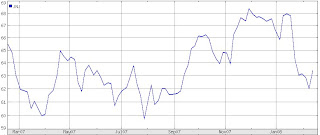
JNJ 1 Year Stock Price Fluctuations
Theoretically, an investor could have purchased JNJ for as little as $173 Billion or as high as $196 Billion over just 52 weeks. Do you really think that Johnson & Johnson's business value fluctuated by $23 Billion? That is what the stock price suggests. Let's look at another company's stock price Apple (AAPL) to see if its price gyrations are equally irrational.


52 weeks ago you could buy Apple for about $73 Billion then it shot up $100 Billion to $178 Billion and now you can buy it for less than $110 Billion. Talk about a roller coaster! Unlike amusement parks -watching charts, stock prices, and the market is hazardous to both your health and your wealth.

A business's value changes much more slowly than the quoted stock price. Over the short term the stock price is a proxy for investors expectations and emotions (two things that, for the most part, should be ignored).

Price Equals Value


Price is what you pay for, value is what you get"
-Warren Buffett


As investors we can profit by purchasing business when there is a large discrepancy between the price the market is offering a company for and the value of the underlying business. It is important to note that business's value isn't quoted on the stock market (or anywhere else) so it will take bit more work to find bargains. In future posts we will explore business valuation tools.

Efficient Markets


If you disagree, believe the market is efficient, or find that the idea that there is a disconnect between price and value inherently flawed, then I suggest investing in a low cost index fund. Please read my post on why indexing matters. There is nothing wrong with investing passively AND earning your fair share of the market's return. I'm very happy that many people subscribe to the Efficient Market Theory (I.e. Price = Value Theory) it creates opportunities for the enterprising investor.

Tea Leaves, Soothsayers, and Technical Analysis


Worse yet, if feel that the charts, and therefor the price, is signaling you and believe in soothsayers, tea leaves, and fortune tellers then you should search for "technical analysis" on your favorite search engine.

Indexing Matters

Want to invest better than most professional and amateur investors alike? Then stop chasing mutual fund returns and heed this advice:

By periodically investing in an index fund, the know-nothing investor can actually out-perform most investment professionals." -Warren Buffett

Time Frame


Year to date the market is down around 9%; not since July 2006 has a month ended with the S&P 500 trading below 1300. Does that matter? No. An investment's success (and failure) should be measured over time frames longer than 17 months. How long? That is topic I'll tackle later. How about a 10 years? Certainly a decade is a sufficiently long enough time frame to determine an investment's success.If we wisely invested in a market tracking low-cost index fund ten years ago, how much would our purchasing power have increased?

S&P 500


To test our 10 year performance let us explore the performance of the Standard & Poor's 500. This index represents the largest 500 companies in the United States with each company's relative weight based on market capitalization (think market price times the number of shares outstanding). Many investors simply refer to the the S&P500 as "The Market." So this index's job is to provide us with our fair share of the stock market's return.

Performance


What has the largest 500 companies in the USA returned to their investors over the last 10 years? 3% (and yes that includes the dividends)! What!?? A lousy 3% including dividends. Let's not even talk inflation.

Three Alternatives to Index Funds: Mutual Funds, No Stocks Market (Bank CD), Do-It-Yourself


#1 You might be thinking to yourself "Certainly we could have done better in mutual funds." That depends on a couple of things. First, what expertize do we have in selecting mutual fund managers? And what does that fund manager's hard work, research, and market beating performance cost?We might have beat the market if we properly selected one of the less than 1 out of every 100 mutual funds that successfully beats the market over longer time frames. That means that for every 1 that does beat the market 99 don't. For that manager's exceptional performance we'd probably pay at least 1.5% annually. That means that our manager needs to earn 4.5% every year that the Market earns 3% just to match the returns of the market. Otherwise we would have been better off just buying the index fund.Ultimately we need to be 100% confidant in our ability to select fund managers that can constantly beat the market in excess of their management fee. With probabilities like that you'd be well advised to stick with the index.

#2 At this point it is easy to get frustrated, run to your nearest bank and get yourself a certificate of deposit yielding a guaranteed 4% and forget the stock market all together. That would be a serious long-term mistake. If you are unwilling (or unable) to explore alternative #3, investing in an Index Fund is a very viable option (much more attractive than a CD). Don't give up.

#3 Fortunately, there is a better alternative than Wall Street's mutual funds, index funds, ETFs, hedge funds, and whateverelse-funds! Using a couple of tools and a few mental models we can successfully invest in businesses (stocks), earn an acceptable (if not damn-right fantastic) rate of return, AND sleep well at night. More on this in my next post.

And alternative #3 is what this blog is all about!